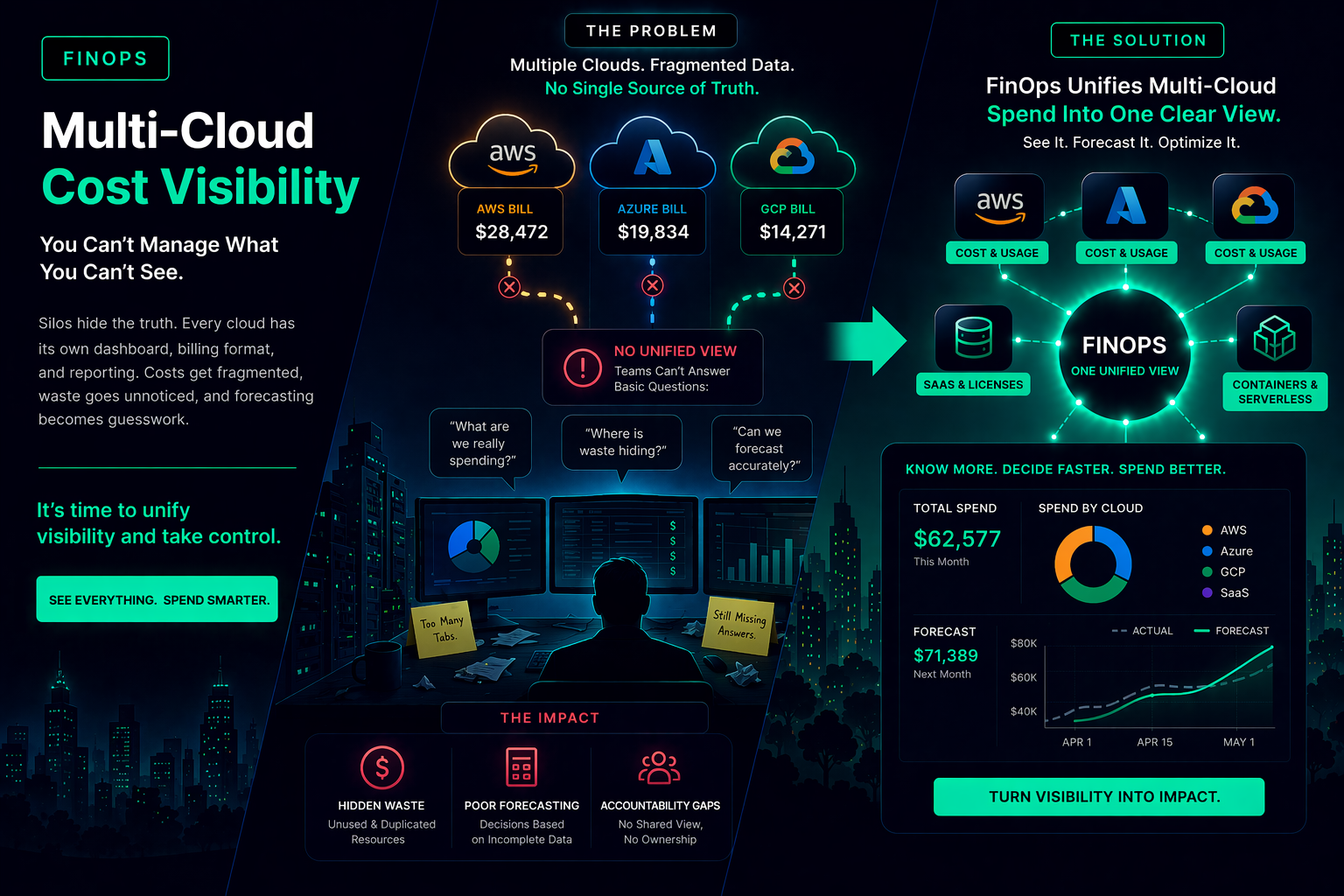
Ask your organization how much it spent on cloud last month. You'll probably get an answer — but only if you count AWS, Azure, and GCP separately.
Now ask for a single number that reflects everything your organization spent on cloud-based infrastructure across all providers, normalized into a consistent view, attributed to the right teams, with costs categorized the same way regardless of which provider generated them.
That question usually gets a pause.
According to Flexera, 89% of enterprises report having a multi-cloud strategy in place, and the average organization uses 3.4 different cloud providers. Multi-cloud is the operational reality for nearly every organization of meaningful size. But the cost management tooling and practices to match that reality lag badly behind.
The 2024 State of Cloud Cost Intelligence Report found that only 30% of organizations knew exactly where their cloud budget was going. That means 70% of organizations have meaningful uncertainty about where their cloud spend is actually landing — despite paying for it every month.
This is the visibility gap. And it's not a billing department problem. It's a structural problem created by how cloud providers present cost data, and how most organizations have never fully reconciled it.
Why Multi-Cloud Billing Is Structurally Fragmented
Every major cloud provider generates billing data in a proprietary format, at a proprietary granularity, with proprietary terminology.
AWS produces Cost and Usage Reports — dense files that Amazon's own FinOps documentation acknowledges are too large to load into Excel at once, split across many separate files. Azure generates billing exports through Cost Management + Billing, with its own account hierarchy, subscription model, and resource group structure. GCP publishes billing data through BigQuery exports with its own project and label taxonomy. OCI has its own cost and usage reports with yet another format.
Each provider calls the same concepts by different names. What AWS calls a "tag," Azure calls a "tag" too, but with different enforcement mechanisms, different inheritance rules, and different coverage across services. What AWS calls an "account," Azure calls a "subscription," and GCP calls a "project." The organizational hierarchy — the structure you use to map cloud resources to business units — is implemented completely differently across all three providers.
The result: reconciling cost data across providers isn't just inconvenient. It requires active normalization work to produce a consistent view. And most organizations do that work, if at all, in spreadsheets that are perpetually out of date and vulnerable to manual error.
What Fragmented Visibility Costs You
The gap between "we have billing access to each of our cloud providers" and "we have a unified view of total cloud spend" isn't just a reporting inconvenience. It creates real financial and operational consequences.
You can't see cross-cloud waste. Idle resources, overprovisioned instances, and redundant services cost money in each cloud. But if you're only analyzing waste within each provider's native tools, you miss the cross-cloud picture — the workload duplicated across two providers during a migration that was never fully finished, the test environments that exist in both AWS and Azure because different teams spun them up at different times, the data stored in multiple clouds with redundant egress charges.
Commitment decisions are made with incomplete information. Committing to Reserved Instances or Savings Plans in AWS requires confidence about long-term compute requirements. But if some of that compute might migrate to Azure or be replaced by GCP services, the AWS commitment analysis is incomplete. Cross-cloud visibility is a prerequisite for confident cross-cloud commitment strategy.
Chargeback breaks at provider boundaries. A team that runs workloads on both AWS and Azure has a total cost that spans two billing systems. If your chargeback or showback process handles each cloud separately, teams see two partial bills rather than one complete picture. The conversation about cloud cost accountability requires a unified number — and you can't have that without unified visibility.
Finance forecasting is unreliable. Finance teams need a total cloud spend forecast to build accurate budgets. If that forecast requires a separate conversation with each cloud's billing dashboard, each provider's anomaly detection tool, and a manual consolidation step, it will be wrong more often than it should be — either because of timing gaps between the data sources or because the consolidation step introduces error.
The Normalization Problem
The deepest challenge in multi-cloud cost visibility isn't access to the data. Most organizations have access. The challenge is normalization — getting cost data from three different providers into a consistent structure where comparisons are meaningful and attribution is consistent.
Normalization requires solving several problems simultaneously.
Taxonomy alignment. Your AWS cost centers, Azure management groups, and GCP folder hierarchy all need to map to the same organizational structure — the same teams, projects, and cost centers that appear in your financial reporting. That mapping doesn't happen automatically. It requires deliberate design and ongoing maintenance as both your cloud architecture and your organizational structure evolve.
Service-level comparability. Comparing "compute cost" across providers is harder than it sounds when AWS EC2, Azure Virtual Machines, and GCP Compute Engine all have different pricing models, instance sizes, and discount mechanisms. A raw comparison of compute spend across providers tells you less than you might think without normalizing for what you're actually buying.
Tagging consistency. Tag-based cost attribution only works consistently if tags are applied consistently — same keys, same values, same coverage — across all providers. In practice, tagging standards drift between clouds, between teams, and between the time a resource is provisioned and when it's reviewed. Managing multi-cloud environments is challenging for 66% of organizations overall, and 80% of enterprises specifically. Tagging governance is a core reason why.
Reporting timing. AWS, Azure, and GCP don't close their billing periods simultaneously. Cost data is available at different latencies across providers, which means a snapshot of "current spend" drawn from all three providers simultaneously includes data of different ages — a subtle but real accuracy problem for anyone comparing monthly numbers.
What a Unified View Actually Enables
The organizations that invest in genuine multi-cloud cost visibility gain capabilities that providers' native tools simply can't deliver.
They can run total-cost conversations with engineering and finance teams without the awkward "this doesn't include Azure" qualifier. They can identify the true cost of a product or workload that spans multiple clouds without a manual reconciliation step. They can compare the cost of running equivalent workloads on different providers with confidence in the underlying data. They can set cross-cloud budgets and track against them in real time.
None of this is exotic. It's the basic expectation for any other category of operational spend. Cloud billing reached this scale years ago. The cost management practices are still catching up.
Cloud spending is expected to reach $1.3 trillion globally in 2025. Organizations that are running on three or four cloud providers without a unified visibility layer are making billion-dollar decisions with a fragmented view of the data behind them.
Reduce normalizes cost data across AWS, Azure, GCP, and OCI into a single view — consistent taxonomy, consistent attribution, consistent reporting — so multi-cloud stops meaning multiple blind spots.